





8 years back in 2015, Psyonix launched its well-acclaimed video game Rocket League. This new launch which may very well be described as a ‘soccer and vehicular pandemonium’ quickly took the gaming world by storm.
Soon after, the concept of Rocket League Trading came into being. Now the word “trading” immediately sends one into a thought trajectory of inventories, price variabilities, and countless hours spent online on the lookout for the best possible offer. All of this very well applies to the game and its conceptualization of the phenomenon as well. However, there is much more in store for players.
Rocket League Trading involves the trading or exchange, to put simpler words, of in-game items present within one’s Inventory. These items vary from car bodies to decals and much more.
Let’s dive into an in-depth analysis of Rocket League Trading and why it has garnered such immense support over the years and is now something integral to the gaming universe.
WHAT IS ROCKET LEAGUE TRADING?
Rocket League trading is a means of increasing player interactiveness in a manner that keeps all parties involved and interested. The algorithm for the process itself is pretty simple.
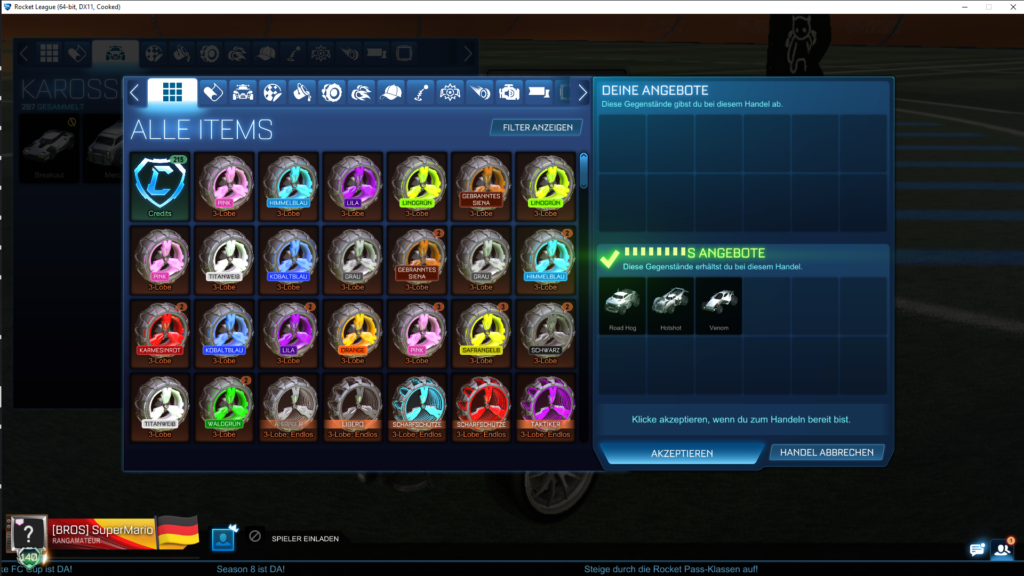
You attract other fellow players by hovering your cursor over their names and inviting them to your party. Once the invitation is accepted, you then display items you would want to trade therein. In return for this, you would also be viewing items that the other party has to offer. Once an agreement is made, you hit the accept button and a barter has now been established!
This, of course, is trading for dummies, and the game itself involves many more intricacies that we will now be delving into.
The Concept of Rocket League Trading

Trading in Rocket League is a sort of barter that allows players to trade in-game items that vary over a wide range. These items go on from anything like decals to car bodies to goal explosions and so on.
The trading mechanism revolves around 2 core areas: in-game trading and external platforms.
The officially established in-game trading platform allows players to engage in deals by interacting with friends or other players.
In addition to this, over time external platforms such as trading marketplaces for game items have developed. These are all owing to the growing popularity of the game and the kind of hold it has on gaming communities all over the world. Such platforms allow even wider player communication with external parties as players list their products and price lists to these audiences.
All items possess unique characteristics which owe to the overall player experience in terms of customization. It also invokes a sense of personalization and increases player interactiveness.
You may also like: 10 Fast Ways to Max Your CoC Account
Getting A Good Trade
The best shot you will have at being a better player in terms of item acquisition would come once you start bagging in new items early. This gives you a headstart on your opponents, alongside ownership of some of the most high-priced items.
Once you have covered solid ground in terms of the items that you possess, it is now equally important to asses the best possible customers for the said items. Common characters that you may run into include those who will try to underpay you, those who are seeking non-crate items, and those who are always on the lookout for BluePrints.
It is simultaneously also important to avoid scammers. Such scammers may include those wanting to “duplicate”; those sending fake links which would be attempts at hacking your account and accessing your inventory and lastly, those trying to trick you by offering an inflated price for a trash item, having you buy the item off of a second scammer who offers a slightly lower price and then taking the original price of the market. Scamming 101, right?
How does the Trade-In Feature work in Rocket League?
The trade-in feature functions to allow you an exchange of 5 items in return for 1 that is higher up on the rarity spectrum. All 5 items must be on the same level of rarity, and if any single item is trade-locked, then the 1 item coming in exchange would also be trade-locked.
The trade-in menu has the inventory divided into 3 subcategories:
- Core items
- Tournament items
- Blueprints
Items that can be traded include golden items, free post-game drops, revealed blueprints, bonus gifts, and free items sharing the same level of rarity.
Items that cannot be traded include items acquired from the items shop, esports shop, crates, blueprints, rocket pass, event stores, and fan rewards.
The menu alongside arranging your items in terms of rarity, also displays how many items you have available for a trade-in, making the process much more simpler and efficient.
Why Is Everyone Indulging In Rocket League Trading?

- Monetary Value: Certain items hold economic incentives in the real world. These are often those that are rare and highly sought after.
- The Gamer’s Experience: The overall gaming experience enhances as you acquire and sell items reflecting feelings of achievement.
- Building Connections: The entire trade barter allows players to build rapport and engage in conversations and negotiations with other players.
- Personalization: Acquiring items specific to your gaming strategy serves to individualize your identity in the gaming verse and is something key to how human emotions pan out.
- Collector’s Instinct: Many players have a knack for forming unique collections via items they acquire.
Conclusion
To sum things up, Rocket League is a game designed to simply have fun! Features such as in-game trading have been inculcated to instill a sense of competition amongst players and to enhance the overall gaming experience. And it does a pretty good job at that.
We hope this article was able to help you develop an understanding of Rocket League Trading dynamics, and why it is as popular as it is, alongside also highlighting important things to be on the lookout for while trading.